I learned a few new phrases recently. The first was courtesy of the bilingual art teacher. It happened while we were doing an exercise applying the principles of tangents of circles (and I was realizing just how long it had been since I had to think of the principles of tangents). One of my students does very well in this class and is always one of the first to finish the geometry exercises. This particular day, other students were asking him for help on the problems and he started to brag(in galician, of course) "Look how clever I am, everyone needs my help, I am the smartest in the class, etc" until finally the teacher said to him "Hombre, no tienes abuela." Roughly that translates to "Geez buddy, you have no grandmother." The idea is, you would only need to praise yourself if you don't have a grandmother. Obviously it's a well known fact that most grandmothers are a constant source of admiration of their grandchildren. I have to say, I really like this saying.
Another saying I learned is a French one, courtesy of Fiona. Of course I learned it in Spanish and not it's original French, but I don't think it loses much in translation. The saying is "Hablas frances como una vaca espanola" or to translate "You speak French like a Spanish cow." She thinks it originates from the time of Franco when many Spaniards emigrated to France looking for jobs, and were not exactly received with open arms. Although my Spanish has definitely improved, I still struggle sometimes with my verb tenses, and now I've started to forget English words. Recently I tried to tell someone I liked the natureness of an area but not the city itself. I think at this point, I speak Spanish like an American cow and English like a Spanish cow. Soy una vaca sin casa. Translation: I'm a cow without a home.
Tuesday, January 31, 2012

Monday, January 30, 2012
Day trip to France!
Back to my Christmas travels! In Germany, they also celebrate Boxing Day on the 26th. Since just about everything in Germany would be closed on the 26th, we got up early and drove to Strasbourg, France with friends of Uncle Dave and Aunt Cindy. As we drove along the autobahn and crossed the border we passed an abandoned customs checkpoint. It seemed strange that we had just crossed a country’s border the same way we cross a state border in the US. The former checkpoint buildings were starting to fall apart and looked rather depressing, so if the EU ends they are going to have to spend a lot of money updating these checkpoints.
 |
| Canals in Strasbourg |
Strasbourg is a really cool city. There are canals running through the city and the buildings are all beautiful! It’s called the Venice of Northern Europe, and we even saw some boats going along the canals. We watched one of the boats go through the locks which was pretty neat to see.
 |
| Strasbourg Cathedral |
 |
| Astronomical clock |
We also saw the Strasbourg Cathedral which was awe-inspiring! The Cathedral was started at the beginning of the 13th century and was completed in 1439. One of the most unique aspects is the Astronomical clock which was added in 1843. Also interesting was the plaque dedicated to the American troops from WWII. Because Strasbourg is in northern France, it was one of the first areas to fall under German occupation.
 |
| WWII Plaque |
The majority of the Christmas markets have their last day the 23rd of December, but the Christmas markets in Strasbourg last until December 31st. And it is Christmas market central, walking through the city we encountered small Christmas markets, large Christmas markets and medium sized Christmas markets. It was like the Goldilocks and the three bears of Christmas markets with the variety we saw! A perk of the French Christmas markets was that since French is a romance language like Spanish, I could at least deduce the majority of the signs, whereas in Germany I had no idea! Unfortunately, although I knew very basic elementary French, when I went to speak to a merchant what came out of my mouth was Spanish. A typical exchange:
Merchant: Deux euros, sil vous plait.
Me: Dos euros. Gracias. (What I thought in my head was deux euros, merci)
Oh well. C’est la vie.
 |
| Christmas Market outside the Cathedral |
I tried some delicious French fair food; I had a baguette with goat cheese and tomato, hot apple cider and a beignet topped with chocolate. Needless to say I am very much looking forward to my next trip to France to try some more dishes. I have to admit, I think the French have pretty good reason to think their food is the best in the world.
I'm trying to do a better job of keeping this updated, so thanks for taking the time to read it!
Monday, January 9, 2012
First day back tomorrow!
I still have more to say about Germany, which I will come back to later, but tomorrow is my first day back after vacation. I have to work three whole days this week, life is so tough here. Tuesday is my busiest day so Mondays I have to set aside a large chunk of time to plan out my lessons. On Tuesdays I teach two English classes in the primary school, two in the secondary school, three private lessons and then finally a bilingual art class so once my day starts it is go, go, go. Today I went to a cafe near my apartment so I could plan my lessons without my computer to distract me. As I was planning my lessons, the strangest thing happened, I actually found myself looking forward to seeing my students again, even the ones who drive me crazy. I feel very prepared for my classes so hopefully tomorrow's lessons will go well. Each day it's a surprise how my lessons will go over. I was not an education major in college and I have no teaching experience so I have been figuring everything as I go along. Some lessons have been really successful, some have felt like utter failures, so hopefully 2012 will start off on a positive note. Wish me luck!
Friday, January 6, 2012
Trier
When I first arrived in Germany, we drove to Trier to check out a Christmas market and see the sights. Trier is awesome because it is the oldest city in Germany and was a capital in the Roman Empire. There is still some of the original city gate, which is called the Porta Nigra, and is the largest preserved city gate north of the Alps. The Porta Nigra is even a World Heritage site. It was awesome to see, and we were even able to go inside.

I’ve discovered Europeans are slightly more lax when it comes to safety regulations at historical monuments. In my area of Spain there are also many preserved Roman ruins, and I’ve started to wonder what the Roman would think if they could see the ruins today. Would they think “Why on Earth has no one repaired the Coliseum, it’s in such disrepair.” Or would they wonder why we haven’t knocked the ruins down yet, since they aren’t being used for their intended purposes. I guess if any ancient Romans could see the world today, they would have a lot more pressing questions. Anyways, it was still really interesting to see the remaining stonework inside the Porta Nigra.

 While exploring Trier, I went to my first Christmas market. It was so fun and I had AMAZING food! First we split potato pancakes with applesauce to dip them in, and then I also had a bratwurst with mustard and gluhwein. For those of you who don’t know, gluhwein is hot mulled wine. In addition to the food it was really neat to see the other booths. There were a lot of artisan Christmas decorations, as well as cooking utensils, polish pottery, handmade jewelry; really there was a bit of everything.
We also saw the Basilica of Constantine, which is also a World Heritage Site. It was built by Constantine at the beginning of the 4th century, and is still used as a church today. In the 17th century an archbishop constructed his palace right next to the basilica, and the palace is still there. It is a little strange to see this impressive basilica and then turn the corner and see the ornate pink palace connected to it.

Thursday, January 5, 2012
Christmas in Germany
Finally I’m getting around to updating everyone on my adventures over Christmas break! Lucky for me, my Uncle and his family live on an American army base in Germany so I was able to spend the Christmas holidays with them. Every day we explored a different place, and I’m already looking forward to going back for Erin’s graduation in June. It will be nice to see Germany when there’s sun. It was so nice to spend Christmas with family. We went to Church on the base for Christmas Eve service. Afterwards we went home, enjoyed gluwhein and some delicious treats, and then opened Christmas presents. On Christmas Day we had a delicious Christmas dinner with friends of Aunt Cindy and Uncle Dave and then watched “A Christmas Story.” Everyone enjoyed when I told them about our family’s Christmas tradition for the past two years, where we go out for Chinese on Christmas Eve. The story is particularly entertaining right after watching “A Christmas Story.”
It was very nice to spend Christmas in Germany near the army base, because I got the best of both worlds. I got to try all sorts of cool things about German culture, and on the army base they sell all things American. Which means peanut butter. Oh how I have missed peanut butter. My mom tried to include it in a package she sent me, but unfortunately the package was held up in Spanish customs and since I was never able to resolve the issue, it should be en route back to the US. At Uncle Dave and Aunt Cindy’s I think I ate my weight in peanut butter fudge, and started every morning with a bowl of peanut butter captain crunch. They even bought me a jar of peanut butter to bring back in my suitcase to Spain. Unfortunately since I had no checked baggage, I had to bring it in my carry-on. And as it is a cream, it violates the liquid rules for carry-on luggage, so it was confiscated. Foiled again. But overall, it was a great visit. More updates to come!
Monday, December 12, 2011
Estamos en crisis
As everyone is well aware, Spain is currently in an economic crisis, as is the majority of the rest of the world. What did surprise me was the extent to which the students were aware of the crisis. On my first day, when students were asking me about the US, they asked me about unemployment in the US and then informed me Spain is currently in a crisis. It is frequently a comment that is thrown about in the classroom, even in the first few grades of the secondary school. I guess I haven’t been in a middle school in the US lately, but I would be surprised to hear that “we’re in a recession” is thrown around as much as they use “estamos en crisis” here.

When I made my presentation on Connecticut for the students in their fourth year of the secondary school, I had some pictures of the capitol and one of the capitol building. I decided to try to impress my students with a fun fact about the capitol building. When I was in fifth grade my girl scout troop toured the state capitol building and for some reason, I remembered that all of the gold leaf that is on the capitol dome could fit in the palm of your hand. I whipped out my fun fact, hoping they would enjoy it, but apparently their take away was not that it’s a surprisingly small amount of gold, but that Spain is in crisis and our buildings are covered in real gold. One of them even said “We’re in crisis, and your buildings are made of gold.” I reminded them that this building was hundreds of year old and reinforced that it is a surprisingly small amount of gold, but I thought it was funny. Especially when you consider how much gold is in the decoration of old cathedrals in Spain.
Tuesday, November 22, 2011
My weekend in Ourense
 |
| Part of the Cathedral |
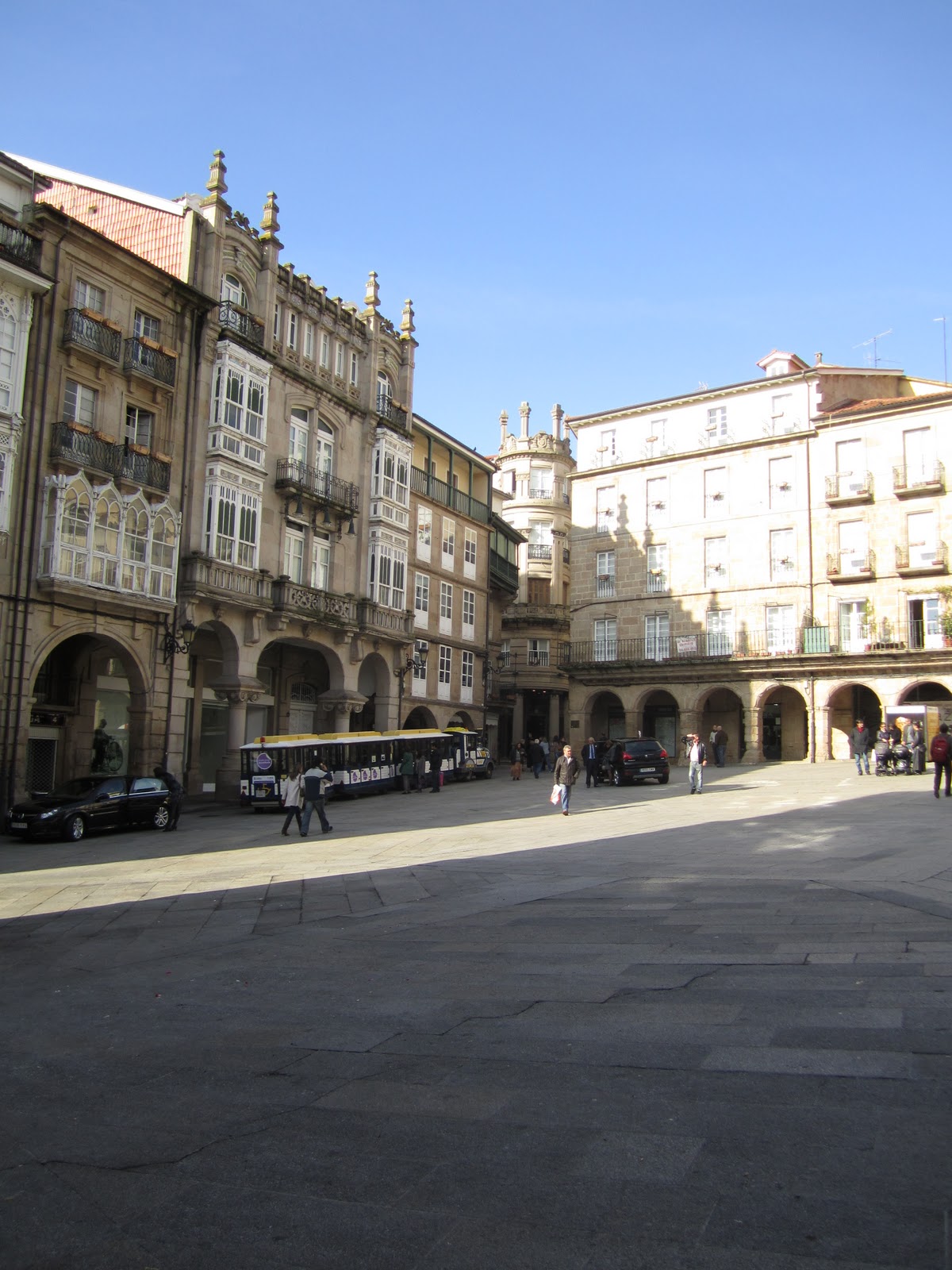 |
| Part of the Plaza Mayor |
 |
| The thermal pool in the city |
 |
| Pools near the river |
Subscribe to:
Posts (Atom)